
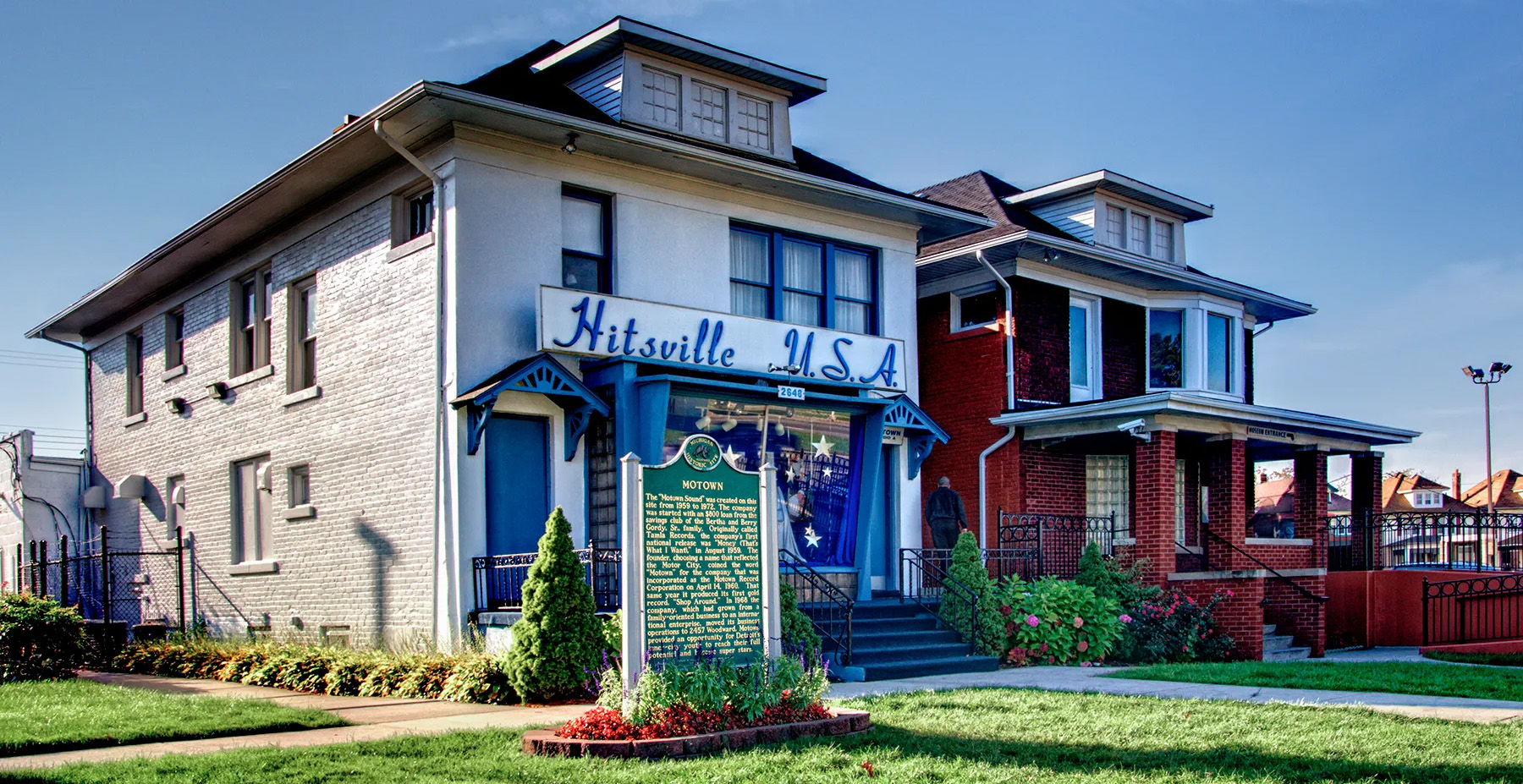
Learn more about Detroit and the Motown Sound
The story of Motown’s empire on West Grand Boulevard is inseparable from Detroit’s history — its urban planning, its jazz scene, and its entrepreneurial drive. Understanding how the company that became known worldwide as Motown came to be starts with the boulevard and the neighborhood that shaped it.
The Boulevard
Hitsville U.S.A. sits on West Grand Boulevard, a street whose scale and ambition trace back to Baron Georges-Eugène Haussmann’s rebuilding of Paris. Between 1854 and 1870, Napoleon III charged Haussmann with reshaping the city: new boulevards, a modern street grid, improved sanitation, and height regulations tying building scale to street width. The Paris we recognize today is largely his creation.
That vision reached Detroit through Bela Hubbard — geologist, attorney, lumber baron, historian, abolitionist, author, and developer — who moved to Detroit from Hamilton, New York in 1835. Inspired by Haussmann’s Paris, Hubbard proposed a U-shaped boulevard meant to mark the city’s outer boundary. The idea took 15 years to gain traction; only after Mayor Hazen Pingree backed it in 1891 and funding was secured did construction begin. Grand Boulevard was finished around 1913.
Combined with the legacy of Antoine Cadillac, Detroit’s first European settler, and Augustus Woodward’s 1806-07 Plan of Detroit (itself inspired by Paris and Washington, D.C.), this Parisian influence earned Detroit the nickname “The Paris of the Midwest.”
That grand vision carried a human cost in both cities. Haussmann’s Paris displaced more than 300,000 people, including 10,000 from the medieval Île de la Cité. A century later, Detroit repeated the pattern: 1950s and ’60s urban renewal and freeway construction displaced thousands, including roughly 7,900 residents of Black Bottom, which the city had likewise labeled a “slum.” Those who could afford it moved to Northwest Goldberg, Virginia Park, or Dexter-Linwood; lower-income residents received little relocation help and were often absorbed into already-crowded housing.
The Neighborhood
The Neighborhood Name
Detroit neighborhood names and boundaries are notoriously contested, and this stretch of West Grand Boulevard is no exception. Many call the area west of the Henry Ford campus “Northwest Goldberg,” bounded by New Center and Virginia Park — named for Northwestern High School and Goldberg Elementary, the latter honoring Louis Goldberg, the first Jewish person to serve as President Pro Tempore of the Detroit School District. Others argue Northwest Goldberg begins west of 14th Street, and that Motown’s block actually belongs to the Elijah McCoy neighborhood, named for the Scotland-educated African American inventor whose steam-engine lubricator reportedly inspired the phrase “the real McCoy.” Still others place the site in the Henry Ford District.
The Neighborhood History
Regardless of name, the area’s history reflects Detroit’s broader migration patterns. Grand Boulevard’s construction opened land to new subdivisions, initially drawing middle- and upper-class buyers — auto tradesmen, manufacturers, real estate agents, school principals, bank managers, merchants.
By the 1920s, Jewish Detroiters relocating from Paradise Valley and Black Bottom settled Northwest Goldberg, Virginia Park, and Dexter-Linwood. That Jewish enclave became one of the few markets open to Black homebuyers, a shift accelerated when Henry Ford began hiring Black workers in large numbers in 1919. Facing segregationist housing laws elsewhere, Black autoworkers, business owners, and professionals moved in to escape overcrowding on the near east side.
The neighborhood kept evolving through mid-century: from the 1940s through the 1960s, many West Grand Boulevard homes were converted into more affordable duplexes, alongside group homes and small offices. It was into this changing, opportunity-rich corridor that Berry Gordy, Jr. would plant his musical empire.
The Company
Berry Gordy, Jr. arrived on West Grand Boulevard well prepared. Following his sisters Anna and Gwen, who launched Anna Records with musician Billy Davis in 1958, Berry founded Tamla Records in 1959 and Motown Records in 1960, building on an $800 family loan and his own songwriting royalties.
He’d spent years earning his stripes: co-writing hits for Jackie Wilson, studying recording at Detroit’s United Sound Systems Studios, and building relationships at jazz clubs like the Flame Show Bar at John R and Canfield. Many future Funk Brothers — the studio band behind countless Motown hits, including Thomas “Beans” Bowles, Earl Van Dyke, James Jamerson, and bandleader Maurice King — got their start backing jazz legends at the Flame before becoming Motown’s uncredited engine room through the 1970s.
In 1959, Gordy bought a two-story house at 2648 West Grand Boulevard, living upstairs while running his fledgling label from the floors below, including the basement Studio A — nicknamed the Snakepit. From there, the empire grew fast. In 1961 he added 2644/46 next door for Jobete Publishing; in 1962, 2650/52 for his and sister Esther Gordy Edwards’ offices and International Talent Management (destroyed by fire in 1971); and in 1965, 2656 — the “Money House” — for finance.
By 1966, Gordy had acquired 2657 across the street for artist development and rehearsals, plus 2622/64 and 2666/68 for sales and marketing, and 2670/72 for International Talent Management’s new home. A row of modest two-family flats had become a hit-making empire.
By 1968, Motown had outgrown even that footprint. Gordy relocated operations to the Donovan Building on Woodward Avenue for a few years before moving the company to Los Angeles in 1971 — the sound of young America departing the boulevard and neighborhood that made it possible.

Learn more about Detroit’s jazz history with Detroit Legacy Tours. The “Bebop, Boulevards, and Boomtown” tour has a unique focus on Detroit’s Paradise Valley neighborhood, where jazz reigned supreme. This walking tour also includes downtown highlights.